How To Calculate Watt Hours On Ebike Battery Metrics
Mastering energy calculations prevents unexpected trail strandings and optimizes pack health. Precise mathematical evaluations ensure your electric bicycle meets strict performance requirements.


Multiply nominal pack voltage by the total ampere-hour rating to determine exact energy capacity. Always use nominal voltage rather than peak voltage for accurate watt-hour totals.
Looking for matching picks? See our Best E Bike Battery For Long Distance: Top Picks.
Practical Quick-Reference Table
| Scenario / Metric | Recommended Target | Why It Matters |
|---|---|---|
| Nominal Voltage | 36V, 48V, or 52V | Defines the electrical pressure driving the system. |
| Ampere-Hours | 10Ah to 25Ah typical | Quantifies total electrical charge stored inside cells. |
| Watt-Hours | 500Wh to 1000Wh range | Measures true energy capacity for total riding distance. |
| Discharge Rate | 0.5C to 1C standard | Prevents premature cell degradation under heavy loads. |
| Cut-Off Voltage | Varies by cell chemistry | Protects lithium-ion packs from deep discharge damage. |
| Ambient Temp | 20°C operational baseline | Maximizes chemical efficiency during energy extraction. |
Fundamental Energy Metrics And Electrical Units
Understanding electrical potential helps technicians accurately evaluate total pack longevity. Multiplying nominal voltage by amp-hour capacity yields precise energy metrics for every modern electric bicycle system.

Energy capacity determines how far a vehicle travels before depleted cells force manual pedaling. Technicians must differentiate between temporary peak voltage and stable nominal voltage during calculations.
Voltage represents the electrical pressure pushing electrons through the controller and motor windings. Higher voltage systems generally deliver increased efficiency under heavy acceleration and steep inclines.
Current measures the volume of electrical flow moving through the circuit over time. Combining these distinct electrical dimensions creates the fundamental baseline for all energy capacity formulas.
Understanding watt-hours requires analyzing electrical potential and current flow over a specific duration. Voltage represents electrical pressure, while amperage measures the rate of electron flow through the circuit.
Energy capacity dictates how far an electric bicycle travels before complete depletion. Nominal voltage establishes the baseline electrical potential of the integrated lithium-ion cells wired in series configurations.
Ampere-hours quantify total electrical charge storage within the physical pack. Combining these two fundamental metrics yields total energy capacity ratings essential for predicting real-world operational ranges accurately.
Manufacturers use standard testing protocols to establish these baseline electrical specifications under controlled laboratory environments. Riders must understand that ambient temperatures significantly alter available discharge energy during daily commutes.
- Nominal voltage reflects the average operational potential of the battery pack.
- Amp-hours measure the total charge capacity stored within the lithium cells.
- Watt-hours represent the total energy available for consumption over one hour.
- Accurate baseline measurements prevent severe range miscalculations on long commutes.
Core Terminology Breakdown
Technical documentation often interchanges terms like capacity and output potential incorrectly. Grasping fundamental electrical units ensures safe handling during diagnostic testing procedures.
Every technician must review technical datasheets alongside our 48v vs 52v ebike battery guide to accurately interpret manufacturer specifications without making costly math or conversion errors.
- Volt (V): The unit of electrical potential difference.
- Ampere (A): The unit of electric current flow rate.
- Watt-Hour (Wh): The standard metric for total energy storage.
Mathematical Formulas For Pack Capacity
Calculating total watt-hours requires a straightforward multiplication of two primary specifications. Take the nominal voltage rating and multiply it directly by the listed ampere-hour capacity.
For example, a standard forty-eight volt pack yields six hundred seventy-two watt-hours. Consult our 48 vs 52 volt ebike battery comparison for exact energy baselines.
Ignoring manufacturer rounding errors ensures your mathematical results remain scientifically sound. Always verify whether the printed label displays nominal values or misleading marketing figures.
Series configurations increase total voltage while parallel groups expand current capacity. Understanding internal cell arrangement clarifies how total energy accumulates inside custom battery enclosures.
Calculating total pack energy demands a straightforward multiplication of nominal voltage by ampere-hour capacity. This fundamental equation provides the theoretical watt-hour rating printed on manufacturer specification labels.
When dealing with custom battery builds, technicians must multiply individual cell capacities by the parallel group count. Series groupings dictate overall voltage output by adding individual cell nominal voltages together.
For instance, a standard 36-volt system paired with a ten-ampere-hour rating yields three hundred sixty watt-hours. Engineers apply derating factors to account for internal resistance losses during heavy acceleration.
Always verify whether your calculations utilize nominal voltage or peak charge voltage to prevent severe mathematical discrepancies. True operational capacity relies strictly on the nominal voltage standard established by cell producers.
- Formula: Voltage (V) multiplied by Ampere-Hours (Ah) equals Watt-Hours (Wh).
- Always use nominal system voltage rather than fully charged maximum voltage.
- Verify parallel cell groupings when calculating custom or rebuilt battery packs.
- Document all mathematical steps to maintain accurate service history records.
Applying Multipliers To Custom Setups
Custom battery builds require careful summation of individual cell group capacities. Miscalculating parallel groupings can introduce dangerous imbalances into the charging circuit.
Checking manufacturer specifications prevents costly errors when upgrading older commuters with high-capacity replacement cells.
- Multiply individual cell capacity by the total number of parallel groups.
- Account for BMS overhead energy consumption during heavy load cycles.
Video Walkthrough: How battery capacity is measured and what is Wh? (Watt Hour)
Measuring Voltage And Ampere Hour Ratings
Accurate measurement begins with a calibrated digital multimeter connected to discharge leads. Checking resting voltage gives technicians a reliable indicator of current state-of-charge percentages.

Ampere-hour verification requires specialized electronic load testers running controlled discharge cycles. Use our e-bike range calculator to project realistic travel distances based on these metrics.
Environmental temperature significantly impacts both voltage stability and total amp-hour delivery during testing. Performing evaluations in a controlled workshop environment eliminates external thermal variables.
Recording data points at regular intervals helps map out the true discharge curve. This detailed profiling reveals degraded cells long before complete battery failure occurs.
Accurate diagnostic evaluation requires a calibrated digital multimeter connected directly to discharge terminals. Measure resting voltage only after the pack has settled for at least two hours following any charging cycle.
Determining true ampere-hour delivery demands specialized electronic load testers capable of constant current discharge. These instruments draw a steady current until the battery reaches its mandated low-voltage cutoff threshold safely.
Avoid relying solely on degraded factory labels when assessing older battery packs experiencing capacity fade. Electrochemical degradation reduces total charge retention capabilities significantly over thousands of operating miles.
Document all multimeter readings alongside ambient temperature logs to maintain consistent records during routine maintenance checks. Proper logging highlights sudden voltage drops indicating potential internal cell group failures.
- Calibrate digital multimeters annually to ensure precise voltage readings.
- Use dedicated electronic load testers for accurate amp-hour verification.
- Maintain a stable workshop ambient temperature of twenty degrees Celsius.
- Record all baseline measurements before initiating deep discharge tests.
Multimeter Calibration Protocols
Using uncalibrated testing equipment introduces cumulative errors into your energy calculations. Regular device verification protects against false diagnostic conclusions during routine maintenance.
Always inspect test lead insulation for cracks or fraying before connecting high-voltage lithium battery terminals.
- Check meter fuses before testing high-current DC power sources.
- Verify zero-ohm resistance on continuity settings prior to diagnostics.
Practical Workshop Testing And Equipment Setup
Setting up a professional workbench requires adequate ventilation and non-conductive surfaces. Organizing your diagnostic tools ensures safe handling of high-capacity energy storage units during testing.
Secure the battery pack firmly using padded clamps to prevent accidental movement. Connecting specialized monitoring equipment safely requires strict adherence to standard workshop safety protocols.
Verify all terminal connections are clean and free from oxidation before testing begins. High contact resistance generates excess heat and skews total energy calculation results.
Monitor temperature sensors closely throughout the entire controlled discharge procedure. Immediate termination of tests is mandatory if cell temperatures exceed manufacturer thermal limits.
Setting up a safe workshop testing environment requires insulated tools, a fire-resistant workbench, and proper ventilation. Always verify your multimeter leads possess CAT III safety ratings before probing live battery terminals.
Connect the electronic load tester securely using heavy-gauge copper leads to minimize voltage drop artifacts. Program the cutoff voltage carefully to protect sensitive chemistry from deep discharge damage during testing phases.
Monitor temperature sensors attached directly to the pack casing throughout the entire discharge cycle. Excessive heat generation points toward high internal resistance within aging welded nickel strips.
Compare your measured watt-hour output against the original manufacturer specification to calculate exact percentage capacity loss. Review our 500 vs 750 watt ebike guide to understand motor draw limits.
- Clear all metallic debris from the immediate testing workbench area.
- Use insulated hand tools rated for electrical diagnostic work.
- Connect data logging equipment to track real-time voltage drops.
- Keep a certified class D fire extinguisher nearby during testing.
Battery Chemistry And Real World Discharge Curves
Different lithium chemistries exhibit unique voltage sag characteristics under load. Understanding these chemical properties explains why calculated watt-hours rarely match real-world riding conditions perfectly.
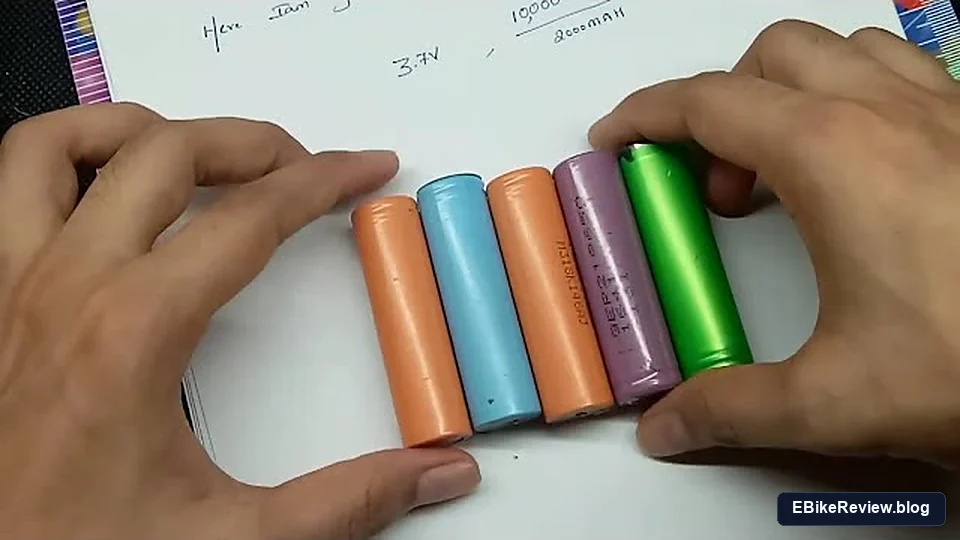
Nickel manganese cobalt cells maintain a flatter discharge curve than older formulations. This stable voltage profile ensures consistent motor performance throughout the entire discharge cycle.
Internal resistance increases as lithium cells age through repeated charge cycles. Higher resistance causes accelerated voltage sag, reducing usable energy output during heavy acceleration.
Wind resistance, rider weight, and tire pressure introduce mechanical variables into energy consumption. Factoring in these environmental losses bridges the gap between theoretical math and reality.
Lithium-ion chemistry exhibits nonlinear voltage discharge profiles during standard operating conditions. Voltage sag occurs under heavy throttle loads due to internal cell resistance interacting with high current demands.
Understanding these discharge curves helps explain why remaining range estimates fluctuate drastically on hilly terrain. The battery management system monitors these fluctuations to estimate remaining energy reserves dynamically.
Different chemistries, such as lithium iron phosphate, maintain a much flatter voltage plateau throughout discharge. This stability simplifies watt-hour tracking but requires specialized displays calibrated for specific voltage thresholds.
Cold weather increases electrolyte viscosity, severely restricting the usable watt-hours available during winter rides. Always factor in temperature derating coefficients when calculating expected range in freezing environments.
- Lithium-ion cells feature distinct voltage sag under heavy throttle loads.
- Older batteries exhibit higher internal resistance and reduced capacity.
- Environmental friction factors directly influence actual operational range.
- Chemical degradation occurs naturally over hundreds of charge cycles.
Common Calculation Errors And Diagnostic Adjustments
A frequent mistake involves using peak charger voltage instead of nominal voltage. This error artificially inflates total watt-hour figures and leads to severe range overestimation on the trail.
Failing to account for controller efficiency losses skews actual power consumption data. Most electronic speed controllers introduce a small thermal loss during power conversion phases.
Double-check all decimal placements when converting milliamp-hours into standard ampere-hours. Simple mathematical oversights can render entire diagnostic spreadsheets completely useless for riders.
Re-evaluating aging battery packs periodically ensures your calculations reflect true capacity. Permanent chemical capacity loss must be factored into all long-term maintenance schedules.
A frequent calculation error involves confusing peak charge voltage with standard nominal voltage metrics. Using 42 volts instead of 36 volts for a standard pack inflates calculated capacity falsely.
Neglecting BMS parasitic drain and internal conversion inefficiencies also skews real-world energy accounting figures. Controllers consume energy while idling, reducing the total usable energy delivered to the hub motor.
Technicians must adjust raw mathematical outputs by applying a realistic efficiency factor around eighty-five percent. This practical adjustment accounts for heat dissipation and electrical resistance losses throughout the wiring harness.
Double-check all unit conversions when mixing milliampere-hours with standard amp-hour ratings during complex multi-pack equations. Precision prevents costly ordering mistakes when replacing damaged cell arrays.
- Avoid using peak charge voltages in standard energy capacity equations.
- Account for typical controller thermal efficiency losses in your math.
- Double-check milliamp-hour conversions to prevent magnitude errors.
- Update historical capacity logs as battery packs age over time.
Long Term Maintenance And Safety Standards
Proper storage practices preserve chemical integrity and prevent premature energy loss. Maintaining a fifty percent charge level during long storage periods protects delicate internal cell structures from stress.
Inspect outer casing housings regularly for physical impact damage or swelling. Promptly retiring compromised battery packs eliminates catastrophic thermal runaway risks in the workshop.
Keep charging contacts clean using specialized electrical contact cleaner sprays. Regular maintenance prevents localized overheating caused by dirty or loose charging connections.
Adhering strictly to manufacturer storage guidelines maximizes overall operational lifespan. Consistent care guarantees reliable energy calculations and safe daily commuting performance.
Maintaining correct watt-hour capacity over years of service demands adherence to strict storage guidelines. Store packs at sixty percent state of charge in climate-controlled rooms when not riding for extended periods.
Comply with recognized safety standards such as UL 2849 certification requirements for complete electrical systems. Regular inspections of the outer casing prevent moisture ingress and catastrophic electrical shorts.
Never charge frozen battery packs, as lithium plating can occur and permanently damage internal cell structures. Allow cold packs to warm up naturally indoors before initiating any charging sequence.
Recycle depleted lithium packs responsibly through certified hazardous waste facilities rather than discarding them in municipal trash. Proper recycling protects environmental ecosystems from toxic heavy metal contamination.
- Store lithium packs at room temperature with moderate charge levels.
- Inspect housing casings frequently for signs of physical swelling.
- Clean electrical terminals regularly to prevent high-resistance joints.
- Retire damaged batteries immediately following strict safety guidelines.
Frequently Asked Questions
What is the formula for calculating watt-hours?
Multiply nominal voltage by the ampere-hour rating to find total energy. Always use nominal voltage for accurate results.
Why use nominal voltage instead of peak voltage?
Nominal voltage reflects the average operating state during discharge. Using peak voltage creates unrealistic capacity inflation in calculations.
How does temperature affect battery capacity?
Cold temperatures increase internal resistance and lower available energy output. Testing at room temperature baseline ensures consistent mathematical calculations.
What causes discrepancies between math and real range?
Wind resistance, rider weight, and controller losses impact energy draw. Real-world conditions introduce variable mechanical friction not found in equations.
How often should battery capacity be re-tested?
Re-test packs annually or after significant mileage accumulation milestones. Tracking degradation helps prevent unexpected out-of-range power failures.