Tern Hsd vs. Tern Gsd: Which Fits Your Setup Better?
Evaluating compact cargo haulers requires contrasting frame geometries and gross vehicle weight ratings. We break down the engineering differences between these two platforms.


Choose the Tern Hsd for solo commuting and light cargo handling, while the Tern Gsd dominates heavy multi-child school runs and commercial freight.
Compare all top models in our Best Electric Bike: Top Commuter Picks for 2026.
Side-by-Side Breakdown
| Criteria | Tern Hsd | Tern Gsd | Edge |
|---|---|---|---|
| Peak Performance & Output | High torque mid-drive system | Maximum output cargo-tuned motor | Tern Gsd |
| Duty Cycle & Consistency | Optimized for daily urban commuting | Engineered for continuous heavy hauling | Tern Gsd |
| Operating Noise & Vibration | Quiet planetary gear engagement | Slightly higher mechanical resonance under load | Tern Hsd |
| Portability & Footprint | Shorter wheelbase for tight spaces | Extended platform requiring more clearance | Tern Hsd |
| Maintenance & Service Life | Standardized bicycle components | Heavy-duty reinforced wear parts | Tern Gsd |
| Power Requirements | Single or dual battery setups | Dual battery high-capacity demand | Tern Gsd |
| Best Ideal Use-Case | Solo riders and light errands | Family transport and heavy freight | Split |
Architectural Frame Geometries and Structural Load Ratings
Frame engineering dictates how cargo bicycles manage weight distribution under maximum payload. The compact footprint of our first contender contrasts sharply with the extended wheelbase of its heavy-duty rival.
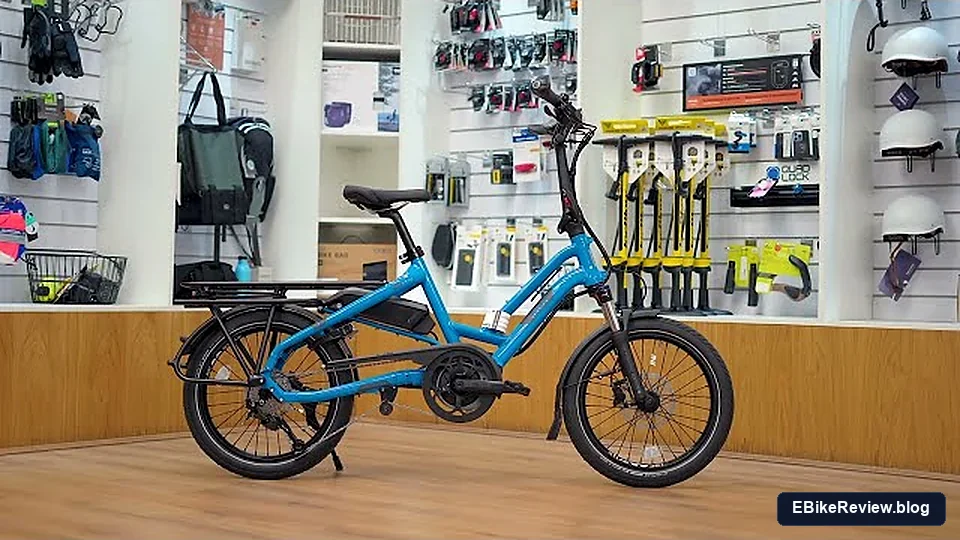
Maximum gross vehicle weight ratings separate these two urban workhorses definitively. You must evaluate your everyday cargo requirements against the structural tubing thickness and rear rack integration limits.
As detailed in our Tern GSD review, this extended long-tail wheelbase measures 183 centimeters, supporting a massive gross vehicle weight rating of 200 kilograms while ensuring low center-of-gravity stability during heavy cargo operations.
Conversely, the compact Tern HSD features a shortened mid-tail architecture spanning 170 centimeters with a certified maximum load capacity of 170 kilograms, prioritizing nimble urban maneuverability over absolute multi-child transport capabilities.
- Shorter wheelbase optimizes maneuverability in tight storage spaces.
- Extended rear deck accommodates two passenger seats securely.
- Reinforced headtubes resist torsional flex under heavy front-loading.
Payload Capacity and Tail-Heavy Stability
Managing a heavy rear payload demands a low center of gravity to prevent steering flutter. Both frames utilize small-diameter wheels to keep cargo packages close to the asphalt.
Weight placement affects low-speed balance significantly when starting from a complete standstill on steep urban inclines. Frame rigidity prevents dangerous oscillation during aggressive steering maneuvers.
- Low deck height simplifies loading heavy cargo boxes.
- Stiff rear triangles eliminate high-speed wobbles.
Mid-Drive Motor Output and Torque Delivery Dynamics
Bosch mid-drive systems power both platforms, translating cadence into seamless propulsion across varying gradients. However, internal software tuning and sensor arrays alter how torque is delivered.
Hill-climbing efficiency relies heavily on sustained thermal management within the motor housing. Continuous high-output operation demands robust heat dissipation fins and efficient gear reduction designs.
Both platforms integrate robust Bosch mid-drive systems, but the GSD leverages high-torque Cargo Line motors producing 85 Newton-meters of assistance to conquer steep inclines effortlessly under maximum gross vehicle weight conditions.
Highlighted in our Tern HSD P9 performance review, this platform employs Bosch motors calibrated for responsive pedal input, delivering 75 Newton-meters of smooth torque optimized for lighter daily commuting and rolling city topography.
- Torque sensors measure pedal pressure one thousand times per second.
- Internal gearing multiplies human input without straining knees.
Battery Capacities and Real-World Range Metrics
Dual-battery configurations provide the extended range necessary for heavy-duty commercial delivery routes. Single-battery setups reduce upfront weight for nimble daily neighborhood commuting tasks.
Voltage sag under heavy acceleration tests the limits of onboard Battery Management Systems. Proper thermal regulation protects lithium-ion cells during high-drain cargo hauling sessions.
- Dual battery mounts eliminate range anxiety on long routes.
- Smart BMS protects against deep discharge cycles.
Drivetrain Configurations and Transmission Durability
Choosing between internal gear hubs and traditional derailleur systems dictates your ongoing maintenance schedule. Belt drives offer cleanliness and longevity compared to exposed steel chains.
Gear range percentages determine whether you can conquer steep neighborhood hills with a full passenger load. Wide-ratio cassettes or planetary hubs are non-negotiable for serious cargo duty.
As explored in our Tern GSD S10 LX review, heavy hauling demands resilient transmissions, utilizing heavy-gauge chains paired with robust internal gear hubs or reinforced derailleur setups designed to resist extreme tensile load stresses.
Premium variants incorporate carbon belt drives requiring zero lubrication, significantly reducing drivetrain maintenance intervals while offering superior resistance against corrosive road salt and abrasive winter grit accumulation.
- Gates Carbon Drive belts eliminate messy chain lubricants completely.
- Environmentally sealed hubs protect internal gears from road grit.
Braking Performance and Hydraulic Stopping Power
Bringing a heavily loaded cargo bicycle to a safe stop requires oversized hydraulic disc brakes. Four-piston calipers provide the clamping force necessary for emergency deceleration.
Rotor diameter and pad compound selection directly influence thermal fade during long alpine descents. Stainless steel rotors must shed heat rapidly to maintain consistent lever feel.
Managing momentum on heavily laden utility e-bikes requires oversized hydraulic disc brakes featuring four-piston calipers paired with thick 180-millimeter rotors to dissipate extreme thermal energy during steep, fully loaded descents.
Rigorous safety standards demand reliable modulation across varying weather conditions, ensuring consistent brake pad contact and preventing thermal fade when halting maximum payload weights from high urban commuting speeds safely.
- Four-piston hydraulic calipers deliver superior stopping leverage.
- Large two-millimeter rotors resist warping under heavy thermal loads.
Ergonomics, Cockpit Adjustability, and Rider Fit
Telescopic seatposts and adjustable stem angles allow a single frame to fit multiple adult riders comfortably. Quick-release adjustments streamline sharing duties between partners of varying heights.
Upright riding positions enhance traffic visibility while reducing lower back strain during long commutes. Handlebar sweep and grip ergonomics prevent hand numbness over rough pavement.
Telescopic seatposts and adjustable stem angles allow both frames to accommodate riders ranging from 150 to 195 centimeters in height without requiring specialized tools or permanent component swaps between users.
The upright riding posture engineered into these cockpits reduces lower back fatigue, while wide handlebars provide superior leverage necessary for steering heavy cargo loads through tight neighborhood traffic circles.
- Speed-Trolley stems adjust handlebar height in seconds without tools.
- Step-through frame designs simplify mounting and dismounting safely.
Storage Footprint, Vertical Parking, and Portability
Urban apartment dwellers require clever storage solutions that minimize the spatial footprint of large cargo bikes. Vertical parking stands allow these bicycles to rest securely on their rear racks.
As noted in our Tern P9 review, maneuvering a long cargo bike through narrow elevator doors tests frame geometry limits, whereas compact designs excel in shared residential buildings where space remains at a premium.
Integrated rear deck handles allow both bicycles to rest securely in a vertical parking position, dramatically shrinking their floor footprint inside cramped apartments, elevators, and crowded commuter train cars.
The compact HSD is exceptionally garage-friendly due to its shorter overall length, whereas the longer GSD requires adequate vertical clearance and careful ceiling height verification when hoisted onto its kickstand.
- Integrated rear grab rails facilitate safe vertical storage positioning.
- Fold-flat handlebars reduce wall protrusion in tight hallways.
Maintenance Protocols and Long-Term Component Wear
Long-term operational costs depend on component durability and resistance to harsh weather conditions. Stainless fasteners and powder-coated frames prevent premature corrosion from winter road salt.
Routine servicing of hydraulic lines and drivetrain components ensures safe, reliable daily transportation. Professional inspection intervals help catch structural fatigue before catastrophic failure occurs.
Routine service schedules require frequent inspection of pivot bolts, spoke tension, and hydraulic line integrity because heavy cargo loads accelerate standard wear rates on structural fasteners and structural joints.
Mechanics should inspect brake rotor thickness and tire sidewalls every five hundred miles to prevent premature failure caused by the constant high pressures exerted by urban utility riding demands.
- Powder-coated aluminum frames withstand aggressive coastal environments.
- Sealed cartridge bearings protect pivots from moisture intrusion.
Frequently Asked Questions
Can both models fit standard bicycle parking infrastructure without causing obstructions?
**Yes.
their innovative vertical parking features allow both bikes to rest securely on their rear racks to occupy minimal floor space.** This clever design ensures you can easily store either machine inside standard apartment hallways or office building elevators
without frustrating your neighbors.
Which electric bike handles steep hill climbs with heavy cargo payloads more efficiently?
The larger model generally provides superior heavy-load climbing stability due to its longer wheelbase and robust motor tuning. However.
The smaller variant still punches well above its weight class when equipped with high-torque mid-drive systems and properly stepped planetary gearing configurations.
Are these cargo platforms compatible with standard child seats and aftermarket accessories?
Both frames are engineered to integrate seamlessly with proprietary cargo ecosystems, including specialized child seats and weather shields. You must verify weight limits and mounting bracket compatibility before purchasing third-party accessories not officially certified by the original manufacturer.
How difficult is it to adjust the handlebars and seatpost for multiple riders?
Both platforms utilize tool-free telescopic seatposts and adjustable stem systems to accommodate riders ranging from short to tall heights. This rapid adjustability makes sharing daily school drop-off and grocery-getting duties between family members remarkably seamless and efficient.
What routine maintenance practices are required to ensure long-term mechanical reliability?
Regular maintenance involves checking hydraulic brake pad wear, inspecting belt or chain tension, and keeping electrical contacts clean. Professional service technicians should also inspect frame pivots and run diagnostic software updates on the drive systems annually.