Mid Motor vs. Hub Motor Ebike: Which Fits Your Setup Better?
Choosing between crank-mounted and wheel-integrated electric drives defines your entire riding dynamic. Understanding internal mechanical torque multiplication and thermal thresholds ensures you select the optimal configuration for your specific daily terrain.

For steep mountain trails and heavy cargo hauling, the mid motor dominates due to mechanical advantage. For flat urban commuting and budget simplicity, a hub motor ebike offers unbeatable value and reliability.
Compare all top models in our Best Electric Bike: Top Commuter Picks for 2026.
Side-by-Side Breakdown
| Criteria | Mid Motor | Hub Motor Ebike | Edge |
|---|---|---|---|
| Peak Performance & Output | Leverages bicycle gear ratios for immense climbing torque | Direct wheel thrust independent of drivetrain gearing | Mid Motor |
| Duty Cycle & Consistency | Superior thermal management under sustained heavy loads | Prone to overheating on long, steep mountain climbs | Mid Motor |
| Operating Noise & Vibration | Internal reduction gears produce slight mechanical whine | Whisper-quiet direct drive or smooth geared operation | Hub Motor Ebike |
| Portability & Footprint | Integrated frame design maintains standard wheel removal | Heavier wheel assembly complicates flat tire repairs | Mid Motor |
| Maintenance & Service Life | Higher chain and cassette wear under high torque | Sealed units require virtually zero drivetrain maintenance | Hub Motor Ebike |
| Power Requirements | Optimized power draw through efficient cadence sensing | Higher baseline wattage needed for steep hill starts | Mid Motor |
| Best Ideal Use-Case | Steep hills, off-road singletrack, and heavy cargo | Flat urban commuting, casual cruising, and budget builds | Mid Motor |
Architectural Foundations and Torque Delivery Mechanics
Mid-drive systems mount directly to the bottom bracket frame junction. This positioning allows the motor to drive the chainring directly, multiplying power through your existing bicycle gears for optimal mechanical advantage.
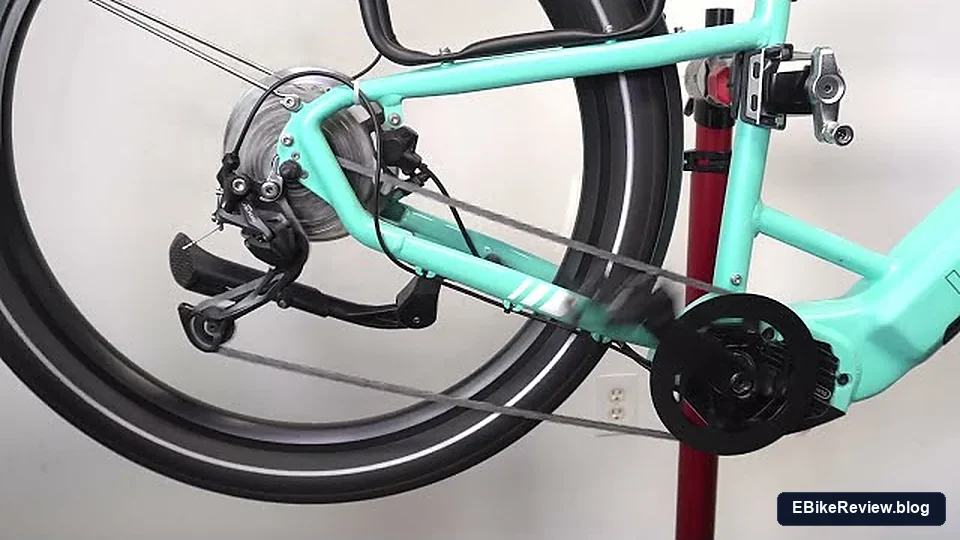
Conversely, hub motors integrate directly into either the front or rear wheel axle. They apply rotational force straight to the wheel rim, bypassing the chain entirely to deliver immediate throttle response.
Engineering these two distinct layouts creates fundamentally different riding experiences. Mid-drives mimic natural human pedaling dynamics, while hub motors function more like traditional motorized throttle vehicles.
- Mid motors utilize internal reduction gearing for high torque output.
- Hub motors spin the wheel shell around a fixed internal stator core.
- Bottom bracket placement concentrates heavy components low and centered.
Cadence Versus Torque Sensing Integration
Advanced mid-drive units featured in our best mid drive ebike under 3000 guide rely on sophisticated torque sensors that measure exact pedal pressure. This delivers seamless power scaling that matches physical exertion.
Many budget hub motors depend on basic cadence sensors that simply detect crank rotation. This introduces a slight delay before motor engagement occurs during initial acceleration.
- Torque sensors measure rider input force up to 1,000 times per second.
- Cadence sensors act as binary switches turning motor power on or off.
Drivetrain Efficiency, Gear Ratios, and Thermal Thresholds
Operating through the bicycle chain enables mid motors to maintain optimal motor RPM regardless of ground speed. By downshifting on steep inclines, the motor avoids dangerous thermal overload during grueling climbs.
Rear hub motors lack mechanical gear reduction advantages. When evaluating the best ebike motor for hills, steep climbs force high current draw, causing rapid heat accumulation and stator damage.
Thermal management dictates long-term durability in demanding environments. Properly cooled mid-drives handle continuous high-wattage loads far better than enclosed hub assemblies trapped inside wheel hubs.
- Mid drives leverage multi-speed cassettes to keep motor RPM in sweet spots.
- Direct-drive hub motors generate significant heat during low-speed crawling.
- Geared hub units include internal planetary gears but still lack shiftable ratios.
Energy Conversion Rates and Battery Draw
Because mid motors utilize human gearing, they convert electrical energy into forward momentum with superior efficiency. Your battery capacity stretches significantly further across rolling terrain.
Hub motors demand higher baseline wattage to overcome inertia from a dead stop. This heavier initial draw drains batteries faster during stop-and-go city commuting scenarios.
- Mid motors preserve battery life by maintaining high operational RPM.
- Hub motors experience efficiency drops during sustained low-speed climbs.
Real-World Climbing Performance and Incline Handling
Tackling steep mountain passes exposes stark engineering differences. Following our bafang motor programming guide helps optimize gear usage, letting the mid motor spin fast and climb effortlessly.
A hub motor tackling the exact same steep incline struggles as wheel speed drops. Without gear reduction, the motor stalls, drawing massive amperage and risking thermal shutdown on long grades.
Off-road mountain bikers heavily favor mid motors for technical singletrack climbs. The balanced power delivery prevents wheel spin on loose gravel and wet roots.
- Mid motors excel on sustained alpine gradients exceeding ten percent grade.
- Hub motors maintain adequate power on moderate hills under five percent.
- Steep technical climbs stall hub motors due to fixed gear constraints.
Traction Control on Loose Surfaces
Delivering power through the crank synchronizes motor output directly with rear wheel traction. Sensors modulate torque instantly to prevent dangerous rear wheel slip on loose dirt.
Hub motors can introduce sudden torque to the rear wheel without pedal feedback integration. This unexpected surge risks breaking traction on slippery or wet pavement corners.
- Crank power delivery preserves delicate rear tire patch grip.
- Axle-mounted motors require careful throttle management on loose terrain.
Component Wear, Maintenance Protocols, and Long-Term Durability
Integrating motor power into the bicycle drivetrain accelerates mechanical wear across your chain, cassette, and chainrings. High-torque mid-drive systems demand frequent chain replacements to prevent premature skipping.
Hub motors isolate propulsion entirely within the wheel assembly, leaving your standard bicycle drivetrain untouched. Chains and cassettes experience normal acoustic bicycle wear, lasting thousands of miles longer.
Servicing a flat tire on a hub motor requires disconnecting heavy wiring harnesses. Choosing an option from our best mid drive ebike under 2000 selection features standard quick-release axles, making trailside repairs considerably faster and cleaner.
- Mid drives accelerate chain stretch due to combined human and motor forces.
- Hub motors protect drivetrain components from high operational stress.
- Wheel removal for flat repairs is complicated on rear hub motor setups.
Internal Gearbox and Motor Servicing
Mid motors feature complex internal nylon reduction gears and clutches that require professional servicing. Specialized tools are mandatory for internal bearing replacements and controller diagnostics.
Geared hub motors contain planetary gears that eventually require grease replenishment. However, sealed direct-drive hub motors offer virtually maintenance-free longevity spanning decades of daily riding.
- Mid-drive repairs often require proprietary manufacturer service software.
- Direct-drive hub motors contain zero moving friction points inside.
Weight Distribution, Frame Geometry, and Handling Dynamics
Placing the motor centrally at the bottom bracket achieves an optimal center of gravity. This balanced weight distribution preserves natural bicycle handling dynamics for confident cornering agility.
Rear hub motors add significant unsprung weight directly to the rear wheel axle. This heavy mass degrades suspension compliance and makes the rear end feel noticeably sluggish and heavy.
Lifting and transporting your ebike is heavily influenced by motor placement. Central frame motors allow for easy roof rack mounting, whereas heavy rear hubs make lifting awkward.
- Central motor placement enhances overall frame balance and agility.
- Rear hub weight increases unsprung load on rear suspension linkages.
- Lifting heavy hub motor wheels complicates vehicle rack loading.
Suspension Performance and Unsprung Mass
Full-suspension mountain bikes require low unsprung mass to track small trail bumps effectively. Adding heavy motors inside rear wheels severely impairs rear shock sensitivity.
Mid-drive motors keep heavy mass on the main frame triangle, allowing rear swingarms to articulate freely. Suspension dampers operate at peak operational efficiency without extra wheel weight.
- Unsprung hub weight reduces rear suspension tracking accuracy.
- Mid-drive frames maintain responsive full-suspension kinematics.
Power Delivery Profiles and Throttle Integration Capabilities
Mid-drive systems focus primarily on pedal-assist functionality, with very few models supporting throttles. This design philosophy encourages active riding and maximizes overall battery efficiency across varied terrain.
Hub motors excel at supporting thumb or twist throttles for effortless motor-only propulsion. This capability makes hub motor ebikes popular for casual cruising and riders with limited mobility.
Matching the power delivery profile to your personal riding style determines satisfaction. Pedaling purists prefer natural crank amplification, while utility riders appreciate the convenience of pure throttle.
- Most mid motors omit throttles to comply with strict Class 1 trail laws.
- Hub motors seamlessly support full-power throttles for instant acceleration.
- Pedal-assist systems require active rotation to unlock electrical output.
Regulatory Classification and Trail Access
Navigating local bicycle infrastructure depends heavily on motor classification rules. Many natural surface trail networks restrict throttle-equipped hub motor bikes while welcoming Class 1 mid-drives.
Urban bike lanes generally accommodate both motor types equally under standard ebike laws. However, verifying regional speed and wattage caps remains critical for legal compliance.
- Class 1 mid-drives enjoy broader access to non-motorized trail systems.
- Throttle-enabled hub motors face stricter regulations on singletrack.
Application Matching: Commuter, Cargo, and Trail Workloads
Heavy cargo hauling and steep urban commuting require the unyielding torque multiplication of mid-drive motors. Transporting children or heavy goods up hills is virtually effortless with proper gearing.
Flat city commuting, delivery work, and budget-conscious riders benefit immensely from hub motor simplicity. Their lower purchase price and minimal drivetrain upkeep deliver exceptional everyday value.
Evaluating your primary daily workload ensures you invest in the correct mechanical architecture. Mismatched motor types lead to premature component failure and unnecessary riding frustration.
- Cargo bikes demand mid-drive torque to conquer loaded inclines safely.
- Flat urban commuters thrive on the low maintenance of hub motors.
- Budget builds utilize hub systems to slash retail manufacturing costs.
Cost of Ownership and Replacement Economics
Upfront purchasing costs heavily favor hub motor ebikes due to simpler manufacturing. However, mid drives offset long-term expenses through superior energy efficiency and battery longevity.
Replacing a worn mid motor out-of-warranty can be expensive. Conversely, replacing a broken hub motor wheel is often a straightforward bolt-on swap procedure.
- Hub motor ebikes offer significantly lower initial purchase pricing.
- Mid-drive systems require budgeting for frequent chain replacements.
Frequently Asked Questions
Do mid motors drain batteries faster than hub motors?
Mid motors actually conserve battery life more effectively than hub motors by leveraging your bicycle gears to maintain optimal motor RPM. This mechanical advantage ensures superior energy efficiency across rolling terrain and steep mountain climbs.
Can I install a throttle on a mid motor ebike?
Most mid-drive systems omit throttles entirely to comply with strict Class 1 trail regulations and encourage active pedaling. However, select specialized models do offer throttle integration for pure motor propulsion.
Are hub motors difficult to service during a flat tire?
Changing a flat tire on a rear hub motor ebike is notably more complex than a standard bicycle wheel. You must carefully disconnect heavy electrical wiring harnesses before removing the wheel axle from the frame dropouts.
Which motor type lasts longer under heavy cargo workloads?
Mid motors handle heavy cargo hauling and steep hills far better than hub motors due to gear reduction protection. This mechanical design prevents overheating, ensuring exceptional long-term durability under extreme loads.
Why do mid motor ebikes cost significantly more?
Mid motors require sophisticated frame engineering, internal torque sensors, and complex bottom bracket gearboxes during manufacturing. These advanced technologies drive up production costs while delivering unmatched climbing performance.